

Una miope
A short-sighted girlie

[English text below]
Me duelen los ojos. Me escuecen, me pican, me lloran, se me secan, se me cierran, pero qué sensación llevar las lentillas puestas y no tener que colocarme las gafas, ni tener que limpiarlas, ni que secarme el sudor de las ojeras y poder ponerme un pañuelo o una diadema o unos auriculares de cascos sin que sienta el lóbulo de las orejas latiendo y colorándose y no verme constantemente un ojo un milímetro más grande que otro porque en un ojo tengo -5 y en el otro -3 con algo.
Dejé de acordarme de mi graduación hace cuatro años, cuando tenía -3,25 y -3-75, porque ya no me importa, porque aparentemente es un número cambiante y bastante tengo con acordarme de los números de teléfono de mis padres, de mi hermana Dara, de mi tía Blanquita, de mi prima Myriam, de casa de mi abuela, de mi amiga Patri y de casa de mi amiga Marta. El de mi hermana Martita nunca me acuerdo porque fue el último teléfono en llegar en algún momento antes del 2010 y ya guardaba todos los números en la agenda del móvil, así que no me lo tenía que aprender de memoria. Si no me sé de memoria el teléfono de Martita, con la que hablo todos los días normalmente en un total aproximado de dos horas y media diarias si no está en época de exámenes, cómo me voy yo a saber mi graduación que sigue cambiando bienalmente.
La primera vez que me pusieron gafas tenía catorce años. Por altura y por atención (o por falta de ella) en clase normalmente siempre estaba sentada en primera fila. En tercero y cuarto de la ESO estuve incluso sentada pegada a la mesa de la profesora. Lo bueno de estar siempre tan pegada a la pizarra es que nunca tuve problemas para ver lo que se escribía, aunque la mayor parte de las veces no me interesara en demasía (disculpen la rima). La primera vez que descubrí que no veía fue la primera semana en el grupo bajo de matemáticas (si no sabes a qué me refiero con eso, te recomiendo que te leas esta newsletter). Estaba sentada en los pupitres de las últimas filas de la clase por primera vez, con uno de mis amigos de la infancia, cuando me di cuenta de que no podía leer lo que ponía en la pizarra.
– Oye, ¿tú ves lo que pone en la pizarra bien o lo ves borroso? – le pregunté.
– Qué va, estoy cegato.
Ante eso no sabía si tranquilizarme, porque entonces lo normal era ver tan mal como estaba viendo yo, o si por el contrario debía preocuparme, porque tanto yo como él éramos básicamente dos topos. El problema se agravó a lo largo de ese curso en actividades que requerían que leyera cosas que estaban escritas a lo lejos, delante de toda la clase. Le conté mi problema a mi mejor amiga y confidente Marta, usuaria de gafas desde tiempos inmemorables por lo menos para mí.
– Marta, que no veo.
Marta me da sus gafas de metal ovaladas de color rojo, su color favorito, y me las pruebo. Esto era muy mala señal, porque de repente lo veía todo mucho mejor. Así pasé las semanas copiándome de los apuntes de los demás cuando me tocaba sentarme más atrás en clase y cruzando los dedos para que no me tocara leer en alto alguna diapositiva que en mis ojos estaban llenas de manchurrones. Una de las veces, el cruce de dedos no funcionó y sonó mi nombre en alto, y tan pronto como lo escuchamos a cámara lenta, Marta mi salvadora se quitó las gafas corriendo y me las dio de estranjis a la velocidad de la luz y yo me las puse enseguida sin que nadie sospechara nada.
El día que decidí que ya estaba viendo lo suficientemente mal como para tener que involucrar a la Abeja Reina (mi madre), le pedí que me llevara al oculista. Mi madre al principio no se lo creía. Es posible que incluso pensara que estaba exagerando. Conociéndola, me imagino que en esos momentos se preguntaba cómo era posible que siendo profesora, no se hubiera dado cuenta antes de que su hija podría necesitar gafas, cuando de sus 25 alumnos de clase sabía quién tenía que ir al oculista, quién al logopeda, quién al traumatólogo, quién al psicólogo y quién a su casa.
Mi amiga Marta me hizo un resumen de todo lo que necesitaba saber:
¿Te acuerdas de que el otro día en clase de música mi madre me mandó una notita para la profesora que decía que tenía los ojos sensibles y que no iba a poder leer? Eso era porque había estado en el oculista, y ahora te van a hacer lo mismo que a mí. Primero, te van a poner unas gotas en los ojos. Pican un poco, pero solo al principio. Esas gotas van a hacer que no puedas leer bien, porque vas a tener los ojos raros y al día siguiente es posible que también. Después vas a entrar en la consulta y Raji te va a decir que le leas unas letras negras de una pantalla con fondo blanco, y te va a mirar los ojos con unas máquinas, pero no duele, te lo prometo. Después te va a probar un montón de gafas raras distintas y te va a decir tu graduación para que puedas comprarte unas y te mandará que te las pongas como yo, para ver la pizarra, para ver la tele o para usar el ordenador.
Marta me tenía como siempre prevenida y preparada para lo que pudiera pasar y todo estaba transcurriendo tal y como ella me había advertido, hasta que llegó el momento de conocer mi graduación. Raji me dijo que tenía -2 dioptrías en cada ojo, pero a mí eso no me decía nada, así que mi madre le pregunto cuándo me tenía que poner las gafas, y yo ya me sabía la respuesta, porque ya me la había dado Marta y en mi cabeza su voz repetía «para ver la pizarra, ver la tele o usar el ordenador», pero estaba equivocada. Los ojos de mi madre y los míos se nos quedaron como los de un cherne cuando Raji pronunció las palabras «Todo el tiempo. La niña tiene bastante falta de vista» por no decir la niña no ve.
Cuando salimos, yo no podía parar de llorar porque al fin sabía por qué no veía la pizarra en el grupo bajo de matemáticas pero también estaba triste porque, efectivamente, no veía.
No quería llevar gafas y especialmente no quería que se me quedara cara de gafas y que se le hiciera raro a la gente verme sin ellas, así que elegí unas montadas al aire muy años 2000 para que se vieran lo menos posible, con la esperanza de que no se me hiciera muy pesada la espera entre los catorce y los dieciocho años, porque mi madre me dijo que cuando los cumpliera me compraría mis primeras lentillas. Pero mi madre, que como Dios, aprieta pero no ahoga, me imagino que entendió pronto que bastante estaba teniendo yo con la adolescencia, los granos, los brackets, mi naturaleza un poco pringada, haber recibido hacía relativamente poco la noticia de que no iba a crecer más y que me iba a quedar con mi metro y medio para siempre (un drama innecesario, ahora que lo pienso), tener que aguantar a otra gente de mi edad que se reía de mí por la calle y me gritaba cosas, como para tener que usar gafas hasta que cumpliera los dieciocho cuando en realidad, no me acostumbraba a llevarlas diariamente.
Así que me compró mis primeras lentillas a los quince años. Diecisiete años, doce pares de gafas y alrededor de doscientos cuatro pares de lentillas mensuales después, me dispongo a usar las gafas diariamente y a cambiar mis lentillas mensuales por las diarias, porque mis ojos ya no son los de una adolescente.
Una aclaración por si lees esto y piensas que soy una estúpida y una exagerada: Probablemente sea las dos cosas. También soy una afortunada, porque sé que en realidad, aunque me queje de que no veo, no tengo demasiada falta de vista, y la que tengo, la puedo corregir con mis gafas y mis lentillas. No me tomen demasiado en serio. En realidad, esto lo he escrito como si fuera la adolescente que fui en ese momento, y la adolescencia es una enfermedad.
¡Gracias por leer una semana más a esta joven miope!
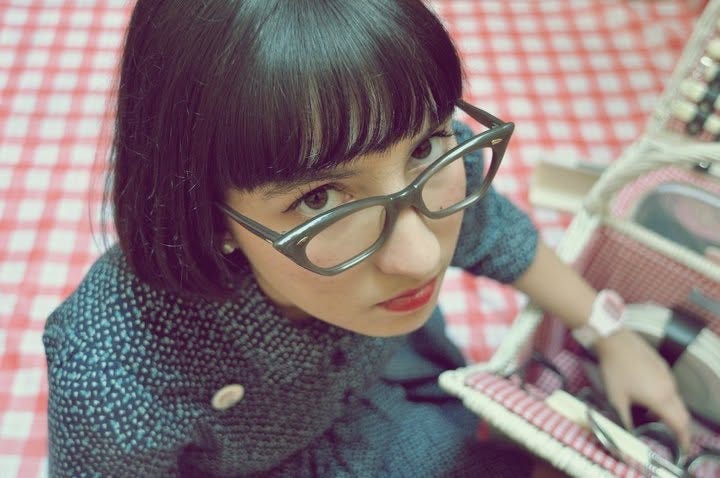
ENGLISH
My eyes hurt. They sting, they itch, they water, they dry out, it hurts to open them. But oh, that feeling of wearing contacts and not having to put on glasses, or clean them, or wipe the sweat from beneath my eyes; of being able to wear a scarf, a headband or over-ear headphones without feeling my earlobes throbbing and turning red; and of not constantly seeing one eye a millimetre bigger than the other because I have a prescription of -5 in one eye and -3-point-something in the other.
I stopped remembering my prescription four years ago, when it was -3.25 and -3.75, because I no longer care. Apparently, it is a constantly changing number, and I already have enough trouble remembering my parents’ phone numbers, my sister Dara’s, my aunt Blanquita’s, my cousin Myriam’s, my grandma’s, my friend Patri’s and my friend Marta’s home number. I can never remember my sister Martita’s because hers was the last phone number to arrive, at some point before 2010, when I was already saving every number in my mobile phone, so I never had to learn it by heart. If I do not know Martita’s number by heart (and I speak to her every day, usually for a total of roughly two and a half hours, unless she is in the middle of exam season) how am I supposed to remember an eye prescription that changes every two years?
I was fourteen the first time I got glasses. Because of my height and my attention span (or lack thereof) I was normally seated in the front row. In the third and fourth year, I even sat right next to the teacher’s desk. The good thing about always being so close to the blackboard was that I never had any trouble seeing what was written on it, even though, most of the time, I was not particularly interested.
The first time I realised I could not see was during my first week in the lower level maths group. If you do not know what I mean by that, I recommend reading this newsletter (although it is only in Spanish at the moment). For the first time, I was sitting at one of the desks at the back of the classroom, next to one of my childhood friends, when I realised I could not read what was written on the board.
– “Hey, can you see what it says on the board, or does it look blurry to you too?” I asked him.
– “No chance. I’m blind, really.”
I did not know whether that should reassure me, because perhaps seeing as badly as I did was perfectly normal, or whether I should be worried because the two of us were essentially a pair of moles.
The problem became worse over the course of that school year whenever we did activities that required me to read something written in the distance in front of the whole class. I told my best friend and lifesaver Marta about my problem. Marta had worn glasses for as long as I could remember.
– Marta, I can’t see.
Marta handed me her oval red (her favourite colour) metal glasses, and I tried them on. This was a very bad sign because, all of a sudden, I could see everything much better.
And so I spent the following weeks copying from other people’s notes whenever I had to sit farther back in the classroom and crossing my fingers that I would not be asked to read aloud from one of the slides, which, to my eyes, were covered in blurry splodges. On one occasion, crossing my fingers failed and my name was called out. As soon as we heard it, in slow motion, Marta, my saviour, whipped off her glasses and slipped them to me at the speed of light. I put them on immediately without anyone suspecting a thing.
The day I decided my eyesight had become bad enough to involve the Queen Bee (my mum) I asked her to take me to the eye doctor. At first, my mother did not believe me. She may even have thought I was exaggerating. Knowing her, I imagine that, at that moment, she was wondering how it was possible that, as a teacher, she had failed to notice that her own daughter might need glasses, when, among the twenty-five pupils in her class, she knew exactly who needed to see an eye doctor, who needed a speech therapist, who needed a traumatologist, who needed a psychologist and who needed to go home.
My friend Marta gave me a summary of everything I needed to know:
Do you remember the other day in music class, when my mum sent the teacher a note saying that my eyes were sensitive and I would not be able to read? That was because I had been to the eye doctor, and now they are going to do the same thing to you. First, they will put some drops in your eyes. They sting a little, but only at first. The drops will make it difficult for you to read because your eyes will feel strange, and they might still feel strange the next day. Then you will go into the room and Raji will ask you to read some black letters from a screen with a white background. He will look at your eyes using some machines, but it does not hurt, I promise. Then he will make you try lots of different weird glasses and tell you your prescription so that you can buy a pair. He will tell you to wear them like I do: to see the board, watch television or use the computer.
As always, Marta had forewarned me and prepared me for anything that might happen. Everything was unfolding exactly as she had described until the moment came to find out my prescription. Raji told me that I had -2 dioptres in each eye, but I understood nothing, so my mum asked him when I would have to wear my glasses. I already knew the answer because Marta had told me, and inside my head I could hear her voice repeating, “to see the blackboard, watch television or use the computer.” But I was wrong. My mum and I stared like a pair of groupers when Raji said the words, “All the time. This girl is quite severely short-sighted,” which was the polite way of saying that the girl could not see.
When we left, I could not stop crying because I finally knew why I had been unable to see the board in the lower maths group, but I was also sad because, as it turned out, I genuinely could not see. I did not want to wear glasses. More specifically, I did not want to develop a “glasses face” and have people think I looked strange without them. So I chose a very early-2000s pair of rimless glasses, hoping they would be as inconspicuous as possible and that the wait between fourteen and eighteen would not feel too unbearable, because my mum had promised to buy me my first contact lenses when I was eighteen.
But my mum must have quickly realised that I already had enough to deal with if we think of adolescence, spots, braces, my naturally rather dorky disposition, the relatively recent news that I was not going to grow any taller and would remain five feet tall for the rest of my life (an unnecessary tragedy, now that I think about it) and the fact that I had other people my age laughing at me in the street and shouting things at me almost everyday. Making me wear glasses until I turned eighteen was perhaps too much, especially when I had never really grown used to wearing them every day. So she bought me my first contact lenses when I turned fifteen.
Seventeen years, twelve pairs of glasses and approximately two hundred and four pairs of monthly contact lenses later, I am preparing to wear my glasses every day and replace my monthly lenses with daily disposables, because my eyes are no longer those of a teenager.
A brief clarification, in case you are reading this and thinking that I am stupid and dramatic: I am probably both. I am also very fortunate, because I know that, in reality, although I complain about not being able to see, my eyesight is not especially bad, and what short-sightedness I do have can be corrected with glasses and contact lenses. Please do not take me too seriously. I have actually written this from the perspective of the teenager I was at the time, and let’s remember that adolescence is an illness.
Thank you for spending another week reading this young short-sighted lady!